The story of Deborah
Table of Contents
The discovery of Deborah
The hunt for the tank at Flesquieres was inspired and led by Philippe Gorczynski, an historian of the Battle of Cambrai, and author of the book ‘Following the Tanks’.
Philippe knew there were persistent stories of a tank abandoned and buried in Flesquières. He was convinced it should be possible to find it, and make it a centre-piece of a monument and museum to commemorate the historic battle.
Local reports about the likely burial place were confusing. A villager, Madame Marthe Bouleux, a teenager in the war, remembered seeing Russian prisoners being ordered by the Germans to push a tank into an enormous hole near a café run by her parents. But early investigation with electronic detectors proved negative – and Philippe’s search was handicapped by the needs of farmers and hunters.
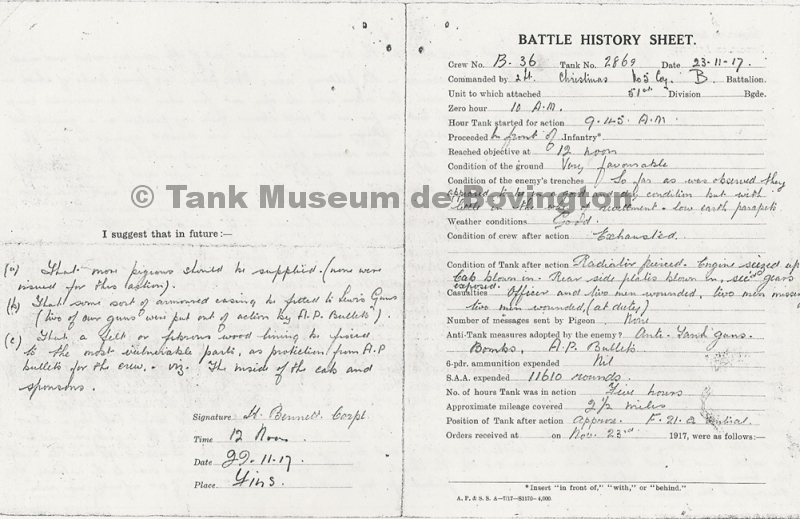
Philippe and his colleagues studied documents in British and German archives, and explored other possible burial sites, in other parts of Flesquieres and in nearby Ribecourt, Villers-Guislain, Bourlon and elsewhere. Some sites were promising, but Philippe’s instinct kept drawing him back to the area indicated by Madame Bouleux.
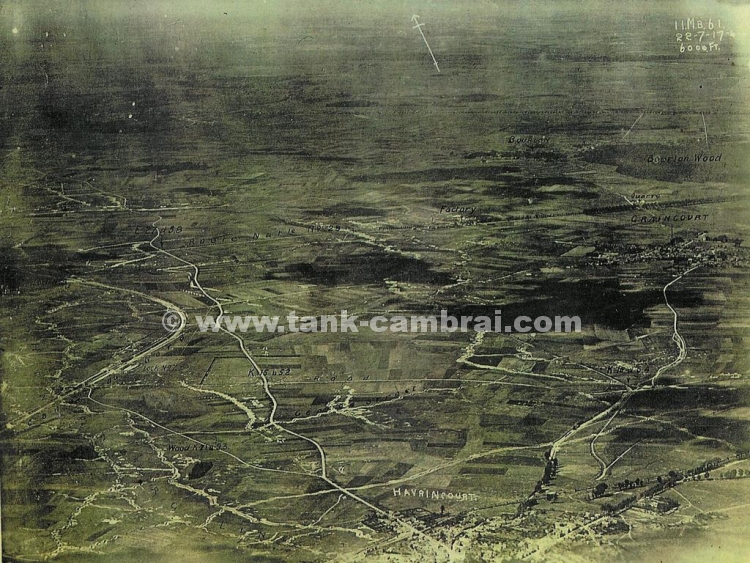
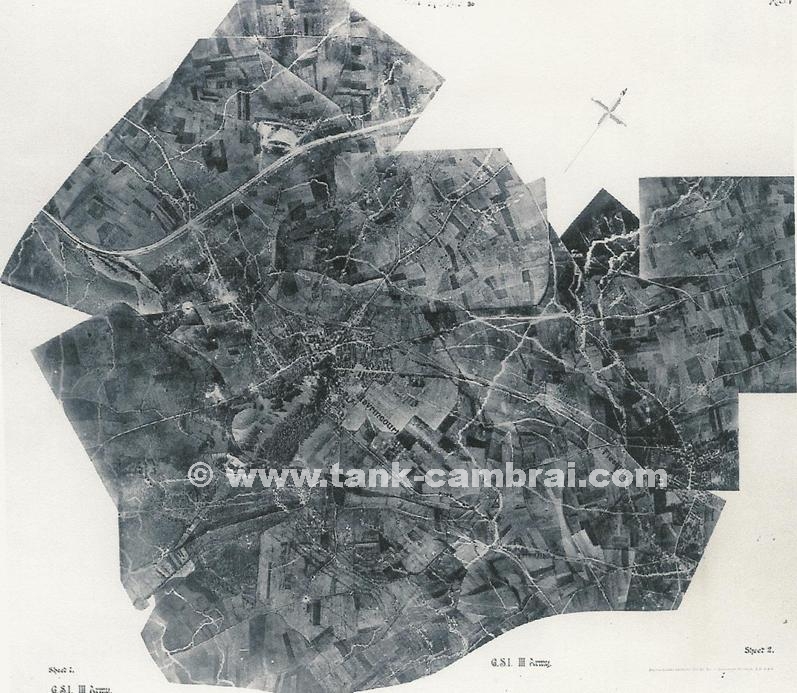
After more than six years of difficult research, documents suggested that the tank might be one from ‘D’ Battalion. Studies of original and modern aerial photographs, together with infra-red photos and powerful metal detection tests, showed there was a large metal object buried in a field belonging to Mesdames Cagnion and Queulain.
Excavation began on 5th November, 1998. The three-man team present comprised Yves Desfosses, responsible for the Regional Archaeological Service of the Nord Department, the excavator driver, and Philippe Gorczynski. After one hour of digging, the roof hatch was revealed. It was obvious the tank had been used a shelter by the Germans or the British. That day nothing more could be achieved, and after entering and exploring the tank interior a number of times, Philippe decided to reseal the entrance for safety.

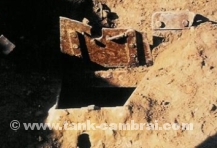
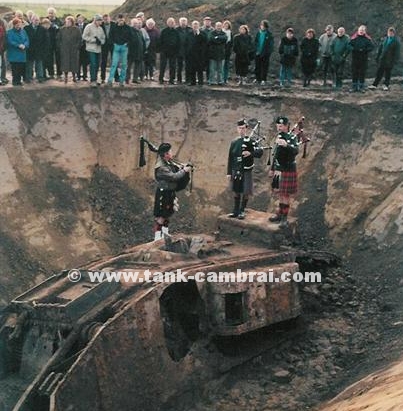
After a few days, the town of Arras, together with Institut Nationale Recherches Preventives, provided a team of professional archaeologists. By 20th November, the 81st anniversary of the Battle, the tank was fully exposed. Many dignitaries and media arrived from all over the world. A special ceremony was held and a wreath laid in memory of those soldiers from the Tank Corps who were killed in the Battle.
Video Deborah is revealed (Skynews)
How Deborah was identified
So a tank had been found, not far from the original site indicated by Madame Bouleux, who unfortunately died before the dig. But which tank was it?
At first, a study of the battle graphs written after the battle by the Company Commander suggested the tank might be D47 Demon II. But the unearthed tank was ‘Female’ – and D47 was ‘Male’.
Which other ‘Female’ tanks were recorded as being destroyed and abandoned close to the burial position? The closest on the battle graphs and reports were D32, D41, D11 – and D51. Unfortunately, positions given in battle graphs are not always accurate; they were written a few days after the action had finished, because Commanders would be pre-occupied and exhausted during combat. In addition, some of Commanders were missing or killed and the information was given by other officers. This has led to some inaccurate assumptions being made by other researchers and published on some websites.

So why was the team positive in its identification of D51 Deborah? It was a combination of these reports, original aerial photographs and other documents. In one original photo of the tank being buried, the full number ‘51’ can be clearly read.
When the earth was carefully removed after the excavation, a slight trace of the original marking appeared on the petrol tank; it was a part of a number ending in ‘1’. Cross-checking indicated that it could only be one of three tanks, D41 Devil II, D11 Dominie or D51 Deborah.
By an amazing coincidence, when David Fletcher, the Curator of the Tank Museum returned to England following the ceremony at the discovered tank, he received a letter requesting information about an enclosed photograph of a damaged tank. Mr Fletcher’s keen interest and sharp eye noticed that the tank photo had the same damage as the tank he had just seen in Flesquieres. On the back was written ‘Mr Heap’s Bus’.
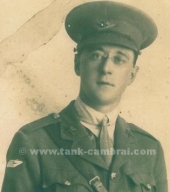
2/Lt. Frank Gustave Heap had commanded D51 Deborah. The request for information had come from his grandson, William Heap. Frank Heap was awarded an MC for guiding half his crew to safety after Deborah was disabled by shell-fire.
Before the war, Frank Heap won a scholarship to read History at the University of Cambridge, where he was a sporting Blue. After 1918, he ran a hotel in Blackpool and became a renowned mountaineer. He also wrote a book about petrol cars and lorries.
Video Frank Heap's Grandson sees Deborah
William Heap subsequently visited Flesquieres to see his grandfather’s tank, and enjoyed a vin d’honneur at the Mairie in the village. Other members of the family have also visited, and provided many photos and documents which add to the story.
Four members of Deborah’s crew died when she was hit on November 20th, 1917. Who were they? There are four headstones side-by-side in Flesquieres Hill Cemetery, not far from where it’s almost certain Deborah was disabled. They each mark the graves of Tank Corps men from Deborah’s ‘D’ Battalion, all killed on November 20th.
John Heap, Frank’s great grandson, a teacher in Cheshire, is part of a team trying to find out more about Deborah’s casualties. One of the four was Gunner William Galway, who was 25 when he died. Research so far has led the team to his family in Northern Ireland.
Other names on the headstones are: Lce Cpl G.C.Foot, Gunner J.Cheverton and Gunner F.W.Tipping.
By lengthy and painstaking research, much information on these soldiers has already been located and is included in the later section ‘The Men of Deborah D51’. Enquiries continue, and anyone with any information is invited to contact this website. Details will be included in the proposed Museum, to honour the men who died.
The history of Deborah prior to Cambrai
The tank, manufactured in England, possibly in Birmingham, was in previous action in Flanders. On 22nd August 1917, Deborah D51, commanded by 2/Lt.George Ranald Macdonald was waiting to go into action in the area of Poelcapelle when she was hit by a shell on the track. The Commander was badly wounded and D51 was replaced by another tank for that action and subsequently repaired. After Flanders the ‘D’ Battalion was sent to the Base Camp in Wailly. On November 6th some tactical training was carried out with the 51st Highland Division. On November 13th the Battalion entrained at Beaumetz-les-Loges and arrived at Plateau station the next day. Fascines [large bundle of wood to assist in trench crossing] were drawn and fitted. On November 18th D51 was entrained at Plateau and detrained at Ytres and drove to the south edge of Havrincourt Wood and made ready for battle.
Deborah in the Battle of Cambrai
Deborah was in No. 12 Section of the 12th Company. Her Section Commander was Capt.G.Nixon and her Company Commander was Major R.O.C.Ward. No. 12 Company formed the second wave of attack in charge of the capture of the Hindenburg support line in the sector west of Flesquieres.
As the tank Deborah entered the village of Flesquieres, the leading company of the 153rd Brigade which was following the tank had to withdraw in face of sustained enemy fire. The ruins and cellars gave perfect cover to snipers and machine gunners and the tank had difficulty in locating them. After the tank had passed, they re-emerged to try and stop its progress. As D51 left the shelter of the last houses in the street, it came under fire from a field gun, and the tank was put out of action. 2/Lt Frank Heap was awarded the Military Cross for his brave efforts. The citation speaks for itself:
“In Cambrai operations near Flesquieres on November 20th 1917, he fought his tank with great gallantry and skill, leading the infantry on to five objectives. He proceeded through the village and engaged a battery of enemy field guns from which his tank received five direct hits, killing four of his crew. Although then behind the German lines he collected the remainder of his crew and conducted them in good order back to our own lines in spite of heavy machine gun and snipers fire”.
D51 Deborah was not discovered until the next day, when the Scottish infantry found it. The four crew who had been killed, were buried next to the tank. After the war the four bodies were re-interred in the Flesquieres Hill British Cemetery.
The village was not retaken by the Germans until March 1918. Until then the wrecked tank remained in British hands, before being abandoned.
Why and how Deborah was buried
Despite the comment made by Madame Bouleux, there is now some doubt as to its complete accuracy. There is over nine hundred yards between the place the tank was destroyed and where it was buried. It is rather difficult to imagine how a whole tank could be moved over that distance by Russian prisoners. Philippe now has the proof she was buried by the British to be used as a shelter. New documents provided by David Fletcher confirm that opinion. D51 was moved by being pulled by other tanks to the hole dug previous to the Battle by German soldiers to establish a concrete bunker. The confusion relating to Marthe’s version may have arisen if some German prisoners assisted in that operation.
Crew of Deborah D51 on the 20th of November 1917
What do we know about the eight men on board D51 as she went into action on that morning of November 20th, 1917?
We know a great deal about the Tank Commander, 2/Lt Frank Gustave Heap. He won the Military Cross for leading some of his crew to safety after his tank had reached the final objective where she was destroyed. Deborah D51 was the only tank to have been through the village on that morning.
We have a picture of 2/Lt Heap. He survived the war, and went on to have a successful business career in the north west of England. He wrote books and was a keen mountaineer. His family has preserved his memory, and many of his descendants have visited Flesquieres and seen Deborah.
But what about the men under his command?
For a long time, it was accepted that four of the crew died when the tank received five direct hits from German field guns. The citation for 2/Lt Heap’s MC referred specifically to ‘four of his crew’ dying.
Inside the neat Commonwealth War Graves Commission cemetery at Flesquieres Hill, on the outskirts of the village, there are four headstones, side-by-side. The names engraved are those of: Gunner J Cheverton, Gunner W Galway, Gunner F W Tipping and Private W G Robinson. They were all killed on November 20th and were members of the 4th [D] Btn. Tank Corps. Were these men, therefore, the four who died together when Deborah was destroyed and are now buried together?
It seemed like a fair assumption, but there was a complication: a fifth 4th Btn Tank Corp man buried very near the others. Lance Corporal George Charles Foot, DCM, was also killed on November 20th. How can we be sure which of these men died when Deborah was shelled?
In an effort to explain the riddle, we examined the files of the Commonwealth War Graves Commission. It was common for casualties to be buried hastily on the battlefield, and then exhumed for reburial after the war in the new military cemeteries. CWGC records show that Lance Corporal Foot, and Gunners Cheverton, Galway and Tipping, were originally buried together (Map Ref 57C K 18d). Private Robinson was at first interred in another place (Map Ref 57E L 13a).
So we concluded that the four men who died in ‘Mr Heap’s bus’ were Foot, Cheverton, Galway and Tipping; Robinson must have been killed elsewhere in the village, in another tank.
Or so we thought.
We began to gather as much information as possible on all these individuals, and the personal details are gathered together on this website. We assembled family portraits, military medals, obituaries, memorial cards, and best of all, we traced descendants – some of whom had little or no idea of what had happened to their brave ancestors.
And then: a major and unexpected development. A nephew of George Foot showed us a hand-written letter from Frank Heap to George’s father, expressing his ‘deepest sympathy’. It is an extraordinarily poignant document.
In the letter, dated November 26th, Frank Heap said: “I am having a bitter evening now, as four more of my men have also gone, all finer fellows than I shall ever be”. This indicates that despite everything we believed before, and despite Frank Heap’s citation, the death toll in Deborah was five, not four. Only two men must have survived with their commander.
We must therefore add Private W.G.Robinson to the casualty list.
The research has been carried out by Rob Kirk, John Heap, Alan Hawkins, Vincent McGarry, John Taylor, Philippe Gorczynski with the support of David Fletcher – Tank Museum – and staff of the Commonwealth War Graves Commission
Tank Commander 2/Lt F. G. Heap
1st Driver Lance Corporal G. C. Foot, DCM
Gunner William Galway
Gunner Joseph Cheverton
Gunner F. W. Tipping
Private W. G. Robinson
Lance Corporal David Marsden
?
Survived (MC awarded after the action)
Killed In Action
Killed In Action
Killed In Action
Killed In Action
Killed In Action
Survived this action
Survived this action
Deborah D51 “D” Battalion Commander
Lieutenant-Colonel W.F.R. Kingdon
Deborah D51,12th Company Commander
Major R.O.C. Ward, Killed In Action
Deborah D51, 12th Section Commander
Captain G. Nixon, Wounded and replaced by Captain E. Smith who became also wounded and finally replaced by Lieutenant A. J. Enoch during the assault on Flesquières.
Deborah D51 Tank Commander until the 22nd of August 1917
The Tank Corps Officer in charge of burying the tank
The Mark IV
The introduction of the Mark IV tank in large numbers in the Battle of Cambrai formed a major turning point in the history of warfare. Experience of the tank at Cambrai quickly led to improvements which played a decisive role in bringing about the armistice. The Mark IV was the result of considerable secret work carried out in England and naturally its introduction took everyone by surprise. The Mark IV was made in two forms named as Male and Female, the difference being the form of weapons.
A few statistics will enable the magnitude of the exercise to be appreciated:
The Male version weighed 28 tons and was equipped with two 6 pounder and four machine guns. The Female weighed 26 tons and had six machines guns. The length in both cases was 8.05 metres and the width, 4.11 metres Male and 3.2 metres Female. The speed was almost 6km per hour [3.7mph]. The engine was a Daimler 105hp high octane petrol. Eight men formed the crew. The Tank Commander was usually a 2/Lt and shared the front cab with the first driver. Behind on each side there were two gunners and one gear man. The two gear men were also called the second and third drivers.
For further detailed and technical information, please refer to the excellent book of David Fletcher titled ‘British Mark IV Tank’ [IBSN 978 1 84603 082 6]